
Clean Beauty Ingredients to Avoid: 2026 List
Table of Contents
- Why Synthetic Chemicals in Skincare Matter
- Top Clean Beauty Ingredients to Avoid
- How to Read Skincare Labels Like a Pro
- Endocrine Disruptors in Cosmetics: What the Science Says
- Safe Skincare Alternatives That Actually Work
- Frequently Asked Questions
Last Updated: October 2, 2026
Why Synthetic Chemicals in Skincare Matter
Your skin is your largest organ, and it absorbs a portion of what you put on it. That single fact is why the list of clean beauty ingredients to avoid keeps growing, and why more shoppers are reading the back of the bottle instead of the front. This guide from Sally B's Skin Yummies walks through the ingredients most often flagged, what the concerns actually are, and how to spot them on a label without a chemistry degree.
Top Clean Beauty Ingredients to Avoid
These are the categories that come up most often when people talk about clean beauty ingredients to avoid. Each one has a different reason for concern, and each one shows up under several different names on a label.
Parabens and Their Health Risks
Parabens are synthetic preservatives used to stop mold and bacteria from growing in water-based products. The concern centers on their ability to mimic estrogen in the body, which is why they're grouped with endocrine disruptors. Look for methylparaben, propylparaben, butylparaben, and ethylparaben on an INCI list. Many brands now print "paraben-free" on the front, which is a start, but check the back anyway.
Phthalates in Fragrances and Plastics
Phthalates help fragrance linger and make plastics flexible. They rarely appear by name because fragrance formulas are protected as trade secrets, so a label can simply say "fragrance" and hide them. This is one of the hardest categories to screen for. Choosing phthalate-free and fragrance-free products is the most reliable workaround.
Sulfates (SLS/SLES) and Skin Irritation
Sulfates are surfactants, the ingredients that make cleansers foam. Sodium lauryl sulfate (SLS) and sodium laureth sulfate (SLES) strip oil from the skin, which can leave the skin barrier compromised and trigger contact dermatitis in people who are already sensitive. If your face feels tight and dry after washing, a sulfate is often the culprit.
Formaldehyde-Releasing Preservatives
These preservatives slowly release small amounts of formaldehyde over time to keep a product stable. Names to watch include DMDM hydantoin, diazolidinyl urea, imidazolidinyl urea, and quaternium-15. Formaldehyde is a known carcinogen, and while the amounts released are small, many people prefer to avoid the category entirely.
The Truth About Mineral Oil and Petroleum
Mineral oil and petroleum jelly are occlusives, meaning they sit on top of the skin and seal in moisture. They're not toxic in the way some other ingredients on this list are, but they're petrochemicals, and they can be comedogenic for acne-prone skin because they trap debris underneath. A common mistake is assuming "gentle" means "good for you." Heavy occlusives can clog pores even when they don't irritate.
Synthetic Colors and FD&C Pigments
Synthetic colors appear as FD&C or D&C followed by a color and number, such as FD&C Red No. 40. They serve no skincare purpose, they exist purely for appearance, and they're a frequent trigger for dermatological sensitivity. For anyone managing a chronic skin condition, skipping added color is an easy win.
| Ingredient Category | Common Label Names | Primary Concern |
|---|---|---|
| Parabens | Methylparaben, propylparaben | Endocrine disruption |
| Phthalates | Hidden under "fragrance" | Hormonal imbalance |
| Sulfates | SLS, SLES | Skin barrier damage |
| Formaldehyde releasers | DMDM hydantoin, quaternium-15 | Carcinogenic exposure |
| Petrochemicals | Mineral oil, petrolatum | Comedogenic, pore clogging |
| Synthetic colors | FD&C, D&C pigments | Contact dermatitis |
How to Read Skincare Labels Like a Pro
Reading a label comes down to four habits: find the INCI list, decode the chemical names, check where each ingredient falls in the order, and cross-reference the ones you can't pronounce. Ingredients are listed by concentration, so anything near the top is present in meaningful amounts, and anything after the preservative is usually present at under 1%.
The INCI Decoding Cheat Sheet
INCI stands for International Nomenclature of Cosmetic Ingredients. It's the standardized naming system used on every cosmetic label sold in the United States, and it's the same system regulators and formulators use. The problem is that INCI names are written for chemists, not shoppers. Here's how the most-flagged categories actually appear on a label:
| What it is | What it looks like on the label |
|---|---|
| Parabens | Methylparaben, ethylparaben, propylparaben, butylparaben, isobutylparaben |
| Phthalates | Often hidden inside "fragrance" or "parfum"; rarely named directly |
| Sulfates | Sodium lauryl sulfate (SLS), sodium laureth sulfate (SLES), ammonium lauryl sulfate |
| Formaldehyde releasers | DMDM hydantoin, diazolidinyl urea, imidazolidinyl urea, quaternium-15, bronopol |
| Petrochemicals | Mineral oil, petrolatum, paraffinum liquidum, isoparaffin |
| Synthetic colors | FD&C or D&C followed by a color and number (e.g., FD&C Red No. 40, D&C Red No. 33) |
| Silicones | Dimethicone, cyclopentasiloxane, cyclohexasiloxane, dimethicone crosspolymer |
| PEG compounds | Anything starting with PEG- followed by a number (PEG-100, PEG-40) |
| Ethanolamines | DEA, TEA, MEA, cocamide DEA, triethanolamine |
The Concentration Rule
Ingredients must be listed in descending order of concentration until you reach 1%. Everything after that point can be listed in any order the brand chooses. In practice, that means:
- The first five ingredients make up the bulk of the formula. If a flagged ingredient is in the top five, it's there in a meaningful amount.
- Anything after the preservative (usually phenoxyethanol, sodium benzoate, or a paraben) is typically present at less than 1%. A paraben listed dead last is a very different formula from one where it's the third ingredient.
- "Fragrance" or "parfum" can legally conceal dozens of individual compounds, including phthalates, because fragrance formulas are protected as trade secrets under federal law. There is no way to know from the label alone what's inside.
- "Preservative-free" on a water-based product is a red flag, not a benefit. Water-based formulas need preservation to prevent mold and bacteria growth. A truly preservative-free water-based product either has a very short shelf life, requires refrigeration, or is relying on an ingredient that functions as a preservative without being labeled as one.
Five Rules That Make This Faster
- Ignore the front of the package. "Natural," "clean," "non-toxic," and "green" are marketing terms with no legal standard behind them.
- Read the INCI list, not the marketing copy. The back of the bottle is the only part with regulated information.
- Watch the first five ingredients. That's where the bulk of the formula lives.
- Treat "fragrance" as a black box. If you're sensitive or avoiding phthalates, fragrance-free is the only reliable screen.
- Don't assume long names are worse than short ones. "Tocopherol" is vitamin E. "Sodium hyaluronate" is a humectant. Learn the suffixes, not the length.
If decoding labels feels like a project, Sally B's Skin Yummies offers What's Really In That Jar?, a $26 digital course that teaches you to read any ingredient list start to finish and tell the difference between "proceed with caution" and "walk away."

Endocrine Disruptors in Cosmetics: What the Science Says
Endocrine disruptors in cosmetics are ingredients that can interfere with the body's hormone signaling. Parabens and phthalates are the two most studied, and both have drawn attention from researchers and regulators. The FDA's page on cosmetics and hormone concerns notes that the agency continues to review the science and that more research is needed on long-term, low-dose exposure.
Safe Skincare Alternatives That Actually Work
Safe skincare alternatives don't require giving up results, and they don't require a luxury budget. The switch is about swapping categories, not sacrificing performance. Most competitors stop at "use natural ingredients" and leave you to figure out the rest. Here's the per-category breakdown, including what you can find at a drugstore price point.
Category-by-Category Swaps
| Product category | Common flagged ingredient | What to look for instead |
|---|---|---|
| Cleanser | SLS, SLES, synthetic fragrance | Cream or gel cleansers built on coco-glucoside, decyl glucoside, or glycerin; fragrance-free formulas |
| Moisturizer | Mineral oil, petrolatum, parabens | Shea butter, squalane, jojoba oil, glycerin; phenoxyethanol or sodium benzoate as preservatives |
| Serum | PEG compounds, synthetic fragrance | Botanical antioxidants (green tea, vitamin C, carrot seed), plant oils, hyaluronic acid |
| Sunscreen | Oxybenzone, octinoxate, synthetic fragrance | Mineral filters (zinc oxide, titanium dioxide); fragrance-free |
| Mascara | Parabens, synthetic colors, formaldehyde releasers | Beeswax or carnauba wax bases, iron oxides for pigment, phenoxyethanol preservation |
| Lip balm | Mineral oil, petrolatum, synthetic flavor | Beeswax, shea butter, coconut oil, candelilla wax |
| Deodorant | Aluminum compounds, synthetic fragrance, triclosan | Baking soda, magnesium hydroxide, coconut oil, essential-oil-free options for sensitive skin |
| Nail polish | Formaldehyde, toluene, DBP | "3-free," "5-free," or "10-free" labeling, the number tells you how many of the flagged solvents were removed |
Budget-Friendly Clean Swaps
You don't need to replace everything at once, and you don't need to spend a lot. A few patterns that hold up across price points:
- Drugstore cleansers built on glucosides or glycerin are widely available at mass retailers and often cost less than the sulfate-based versions they replace.
- Single-ingredient oils, jojoba, rosehip, squalane, double as serums and moisturizers and are sold at most pharmacies and natural grocers. One bottle replaces two products.
- Mineral sunscreens with zinc oxide or titanium dioxide are now stocked at every price tier, from mass-market to prestige.
- Fragrance-free is the single highest-leverage swap. It eliminates the phthalate category, most sensitizers, and a large share of contact-dermatitis triggers in one move.
- "3-free," "5-free," and "10-free" nail polishes are widely available at drugstores; the higher the number, the more flagged solvents have been removed.
Where to Start
Start with the products that sit on your skin the longest, moisturizers, serums, and leave-on treatments, because those have the most contact time. Then work outward to rinse-off products like cleansers, where exposure is brief. Sunscreen and foundation sit on your skin all day, so they're worth prioritizing once the leave-on basics are swapped.
Frequently Asked Questions
What ingredients should I avoid in my face wash?
Check for sulfates like SLS and SLES, which strip skin of natural oils and cause irritation. Avoid parabens (methylparaben, propylparaben) and synthetic fragrances listed simply as 'fragrance' or 'parfum.' Also skip formaldehyde-releasing preservatives such as DMDM hydantoin. A safer face wash uses gentle plant-based surfactants and preservative systems like sodium benzoate or potassium sorbate.
How can I identify toxic chemicals on a product label?
Start with the INCI list, which lists ingredients by concentration. Look for parabens ending in -paraben, phthalates often hidden under 'fragrance,' and sulfates ending in -sulfate. Check for formaldehyde releasers like quaternium-15. If a label says 'preservative-free' but contains water, that is a red flag because water-based products need preservation to prevent mold and bacteria growth.
What does 'clean beauty' actually mean in the industry?
There is no legal definition of 'clean beauty' in the US, so brands use it loosely. For a product to be genuinely clean, look for third-party verification such as EWG Verified, which screens against strict health and transparency criteria. Also check for Leaping Bunny certification for cruelty-free claims. Avoid brands that use 'clean' as marketing without ingredient transparency or independent testing.
Are endocrine disruptors in cosmetics really a concern?
Yes. Ingredients like parabens, phthalates, and certain UV filters can mimic or interfere with hormones. The concern is cumulative exposure from multiple products used daily. While individual doses are small, the FDA does not require pre-market safety testing for most cosmetic ingredients. Switching to paraben-free and phthalate-free formulas reduces your overall body burden over time.
What are safe skincare alternatives to synthetic ingredients?
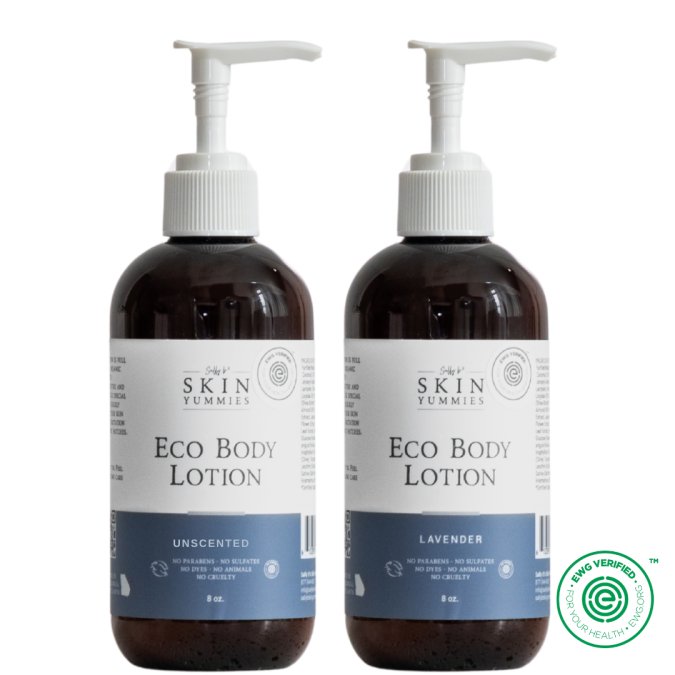
Look for plant-based oils like jojoba, shea butter, and coconut oil for moisture. Use essential oils instead of synthetic fragrance, though patch-test first if you have sensitive skin. For preservation, sodium benzoate and potassium sorbate are safer choices. Brands like Sally B's Skin Yummies offer EWG Verified options that avoid parabens, sulfates, and artificial fragrance while still delivering anti-aging and moisturizing benefits.
Leave a comment